FEDERAL PRISON PREPARATION GUIDE
What Happens During Federal Prison Intake? First-Day Guide
Reviewed and updated September 3, 2026.
If you are preparing to self-surrender, the intake process may be one of the biggest unknowns. You may be wondering what happens after you enter the institution, when you will receive clothing, where you will sleep, what questions staff will ask, and when you can contact your family.
This guide is for people reporting to a federal Bureau of Prisons institution and for family members trying to understand the first hours and days. The exact order and timing vary by facility, staffing, arrival time, medical needs, and security conditions, but the main purpose is consistent: staff must process your arrival and determine whether you can safely enter the institution's general population.
The short version: what federal prison intake includes
Federal prison intake commonly involves several connected steps:
- Arrival and transfer into institutional custody
- Identity, records, and property processing
- A private social and safety interview
- Medical screening and mental-health questions
- A housing decision based on the available information
- Issue of basic institutional property
- Placement in a housing unit or another temporary location
- Admission and Orientation after the immediate intake process
These steps may not happen in a perfectly smooth order. Waiting is normal. A late arrival, unresolved medical concern, missing information, or need for additional review can change the timeline.
1. Arrival and initial processing
Follow the exact reporting location and time in your official instructions. When you arrive, tell staff that you are reporting to serve your federal sentence and follow each direction calmly. Once processing begins, your freedom to contact others or change plans will be limited.
Do not assume your family can remain with you through intake. Before arrival, make sure your driver knows what to do with your phone, keys, wallet, vehicle, and any property that cannot enter the institution. My separate guide explains what you may be able to bring when self-surrendering.
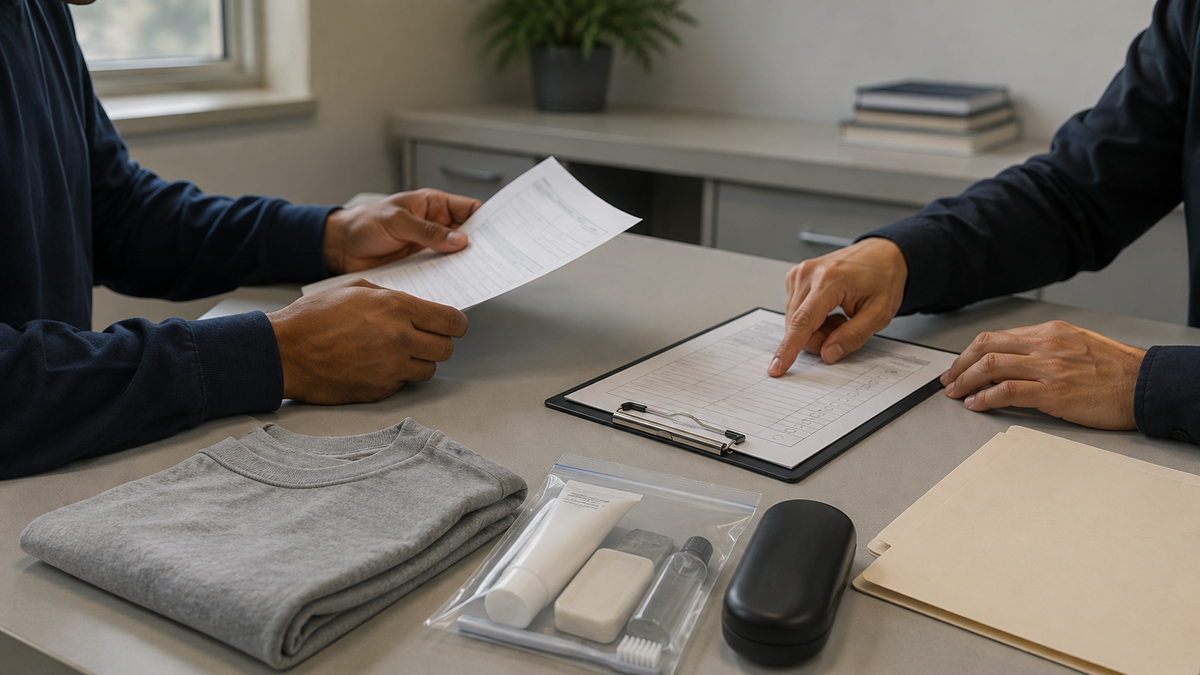
2. Property review and institutional clothing
Your personal property will be reviewed and handled according to national policy and the institution's local rules. Unauthorized items may be mailed out, stored, destroyed, or treated as abandoned. The current national policy is BOP Program Statement 5580.10, Inmate Personal Property, dated May 7, 2026.
The BOP's Entering Prison guidance states that the institution issues clothing, hygiene items, and bedding and provides laundry services. Civilian clothing ordinarily is not authorized for retention. The exact items and timing can vary, so expect to work with what the facility issues first.
3. The social and safety interview
BOP Program Statement 5290.15, Intake Screening requires a social interview before a newly arrived person is placed in general population. The interview is supposed to be conducted privately by trained staff.
Staff may review available records, including information from the Presentence Investigation Report, central file, and BOP systems. The interview helps identify safety concerns, separation issues, emotional distress, prior victimization, aggressive behavior, and reasons a person may need to be housed away from the general population.
Answer honestly and clearly. This is not the time to minimize an urgent medical or safety issue, but it is also not helpful to guess, exaggerate, or tell a long unrelated story. If there is a genuine threat, a person you must be separated from, a risk of self-harm, or another immediate concern, state it directly.
4. Medical and mental-health screening
Federal policy requires a medical screening within 24 hours of arrival, with some institutions normally completing it immediately. This screening is not necessarily the full medical evaluation that may occur later. It is intended to identify conditions that affect immediate housing, safety, treatment, or temporary work restrictions.
Be ready to provide accurate information about:
- Current prescriptions and dosages
- Medication allergies and serious reactions
- Chronic illnesses and recent hospital care
- Medical devices and mobility needs
- Current pain, injury, withdrawal risk, or infectious symptoms
- Mental-health treatment and current symptoms
- Thoughts of self-harm or suicide
Do not stop or change prescribed treatment without medical advice. Medication brought into the institution is reviewed by Health Services, and you may not be allowed to retain your personal supply. Preparing a written medication and medical-history summary before surrender can help you answer questions accurately.
The BOP also states that people receive information about available mental-health services during admission and orientation. If you are in crisis, report it immediately rather than waiting for the later orientation program.
5. Housing placement after screening
Staff use the screening results to decide whether there are health, safety, or security reasons you should not immediately enter the general population. At some institutions, a person who cannot be cleared promptly may be held in a more restrictive or temporary setting while staff complete the necessary review. Camps and certain satellite facilities may use different procedures because separate intake housing is not always available.
A temporary placement does not, by itself, explain the final reason or predict where you will remain. Avoid making promises to family members about exactly where you will sleep that night or when you will reach a regular housing unit.
6. Forms, rules, and acknowledgments
During intake, staff may explain rules concerning correspondence, the handling of funds, monitored telephone calls, unmonitored attorney calls, emergency notification, and disposition of property. BOP intake policy provides for acknowledgment forms documenting that this information was explained.
Listen carefully, ask a concise question when you truly do not understand, and do not sign blindly. At the same time, understand that intake may feel rushed and procedural. You will have more opportunities to learn the institution's rules during Admission and Orientation.
7. Intake is not the same as Admission and Orientation
Immediate intake screening focuses on whether health, safety, and security requirements are met. Admission and Orientation, often called A&O, comes later and introduces the institution's programs, services, policies, and procedures.
A&O may cover housing-unit expectations, counts, work assignments, education, recreation, religious services, medical access, communication, commissary, discipline, and other local rules. Every institution operates somewhat differently, so its current handbook and staff instructions matter more than assumptions based on another facility.
When can you call your family?
Do not promise that you will call immediately after surrender. Access depends on completing processing, housing placement, account or contact procedures, equipment availability, and local conditions. A delay does not automatically mean that something is wrong.
Before reporting, give your family a realistic expectation: there may be a period when they do not hear from you. Agree on who will update others, keep important phone numbers written down, and make sure family members use official BOP channels rather than paying an unverified third party for information.
How to handle the first day
- Stay calm, respectful, and observant.
- Follow direct instructions without trying to control every step.
- Give accurate answers during medical, mental-health, and safety screening.
- Keep requests short and focused on immediate needs.
- Do not discuss your case details casually with other incarcerated people.
- Do not accept debts, favors, food, or property you do not understand.
- Expect waiting, repetition, and changes in the order of events.
- Learn the rules of the housing unit before assuming that another institution works the same way.
My firsthand perspective
I had a mandatory minimum of 60 months, was sentenced to 70 months, and served 50 months in total custody after self-surrendering to a medium-security institution and later serving at low and camp security levels. I remember how much uncertainty surrounds the first day. During transit, I also met two knowledgeable men with a combined 19 years of state and federal prison experience. Their preparation helped me understand what mattered, what did not, and how to enter the system with fewer avoidable surprises.
That is the same underlying approach I use with clients. Much of the basic information is consistent, but useful preparation must be tailored to the person's facility, health, family responsibilities, prior experience, and concerns. No consultant can control the institution's decisions, but good preparation can help you communicate clearly and respond more thoughtfully.
Frequently asked questions
Will I go directly to the general population?
Not necessarily. Staff must complete required screening and may use temporary or more restrictive housing if additional review is needed. Procedures differ at camps and some satellite facilities.
Will I receive a complete physical examination immediately?
Federal policy requires intake medical screening within 24 hours. A more complete evaluation may occur later.
Should I tell staff about mental-health symptoms?
Yes. Report current symptoms, self-harm thoughts, medication needs, or a genuine crisis honestly and immediately. Do not wait for formal orientation.
Will my family hear from me on the first day?
Possibly, but you should not promise it. Processing, housing, communication setup, and local conditions can delay contact.
Is federal prison intake identical at every facility?
No. National policies establish core requirements, but the order, pace, staffing, local instructions, and available housing differ.
Prepare before your reporting date
If you want help understanding the intake process, organizing your medical and family information, and building a practical self-surrender plan, book a free 30-minute consultation. I will introduce myself, explain my experience, learn about your circumstances, and discuss whether my paid hourly or package-based preparation support is a good fit.
You can also review the federal self-surrender checklist, my intake and first-days preparation page, and the federal prison preparation FAQ.
This article provides educational guidance based on firsthand experience and publicly available information. It is not legal or medical advice and does not replace instructions from the court, U.S. Marshals Service, Bureau of Prisons, an assigned institution, a licensed healthcare professional, or your attorney. No placement, program eligibility, sentence reduction, release timing, safety, or legal outcome is guaranteed.
FIRSTHAND PERSPECTIVE
I’ve been where you’re going.
I served 50 months in federal custody across a medium, low and camp. These resources share the perspective I wish I had before entering custody. They do not replace legal advice or official Bureau of Prisons information.
Read my story →NEED HELP APPLYING THIS TO YOUR SITUATION?
Tell me what you’re facing.
The first 30-minute consultation is free. No need to choose a service before we speak.
Book a free 30-minute consultationNo obligation.